Sociocracy
Sep 30, 2016Jul 06, 2026
A report from the Agile Saxony Community meeting on 21/09/2016
That evening, Birgit Mallow inspired us with a varied talk on sociocracy, its origins, core principles, and its relevance in an agile context. In her presentation she included a simulation of consent decision-making, a core principle for making decisions, and at the end she tried to highlight similarities and differences to Holacracy® – a successful, intensive, and interactive evening at Agile Saxony.
For around 20 years, Birgit Mallow has worked as an organizational developer and management consultant. She works as an Agile Coach, Agile Facilitator, and sociocratic moderator and described the basic principles of sociocracy to us in a very vivid way. The origins of sociocracy go back to the 19th century. Its current form was developed by Gerard Endenburg in his own company. The main goal is to integrate as many people as possible into decision-making processes, with everyone being equal and able to influence a decision with a valid objection. In this way, every contribution can receive the appreciation it deserves. Remarkably, companies in the Netherlands can dispense with a works council today if they are run sociocratically.
https://twitter.com/AgileSaxony/status/778650440917540864
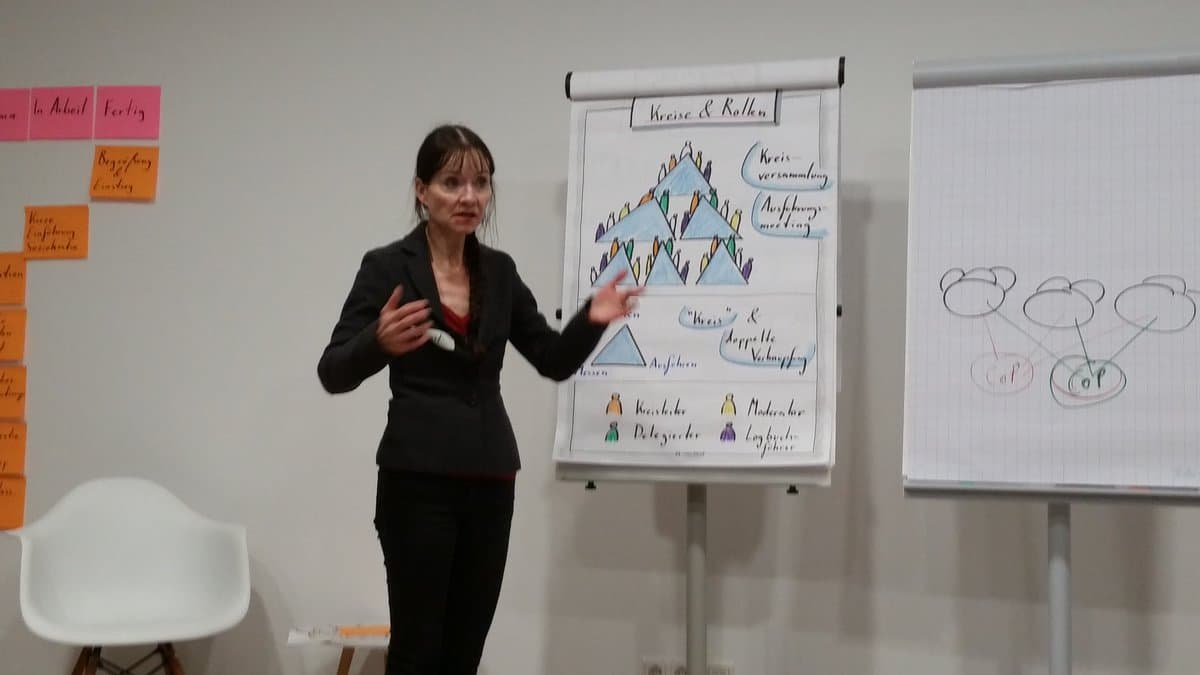
Birgit introduced us to the four basic principles of sociocracy. Similar to Holacracy®, there are circles that autonomously make fundamental decisions within their domain. Decisions are made according to the consent principle. Delegates from the superior and subordinate circles result in a double linkage in the form of representatives. These are also reflected in the role types within the circles: circle leader, delegate, facilitator, and logbook keeper. A strict separation of roles enables the impartiality of the facilitator and transparency through the recording of every decision. This allows the representatives to bring in the concerns of their circles or to carry decisions back into their circles. The fourth basic principle is open election. A distinction is made between circle assemblies, the governance meetings, and the operational meetings, where the resolutions for day-to-day operations are implemented in accordance with the established guidelines. Decisions are also given an expiration date, creating a continuous PDCA cycle: Plan, Do, Control, and Act.
Democratic decisions have the disadvantage that minorities are not taken into account and majorities “have to be obtained.” This often leads to pseudo-discussions and decisions being made that were actually taken long before by alliances. With consensus decisions, everyone has to agree. However, these can go on endlessly, since there is almost always someone who does not share the opinion of the others. The consultative individual decision does take other people’s opinions into account, but in the end a single person still makes the decision. In systemic consensus solution proposals are collected and it is determined for which of these approaches the group feels the least resistance.
The consent process always follows a specific pattern. First, a proposal is presented, indicating which decision is to be made. After that, clarifying questions can be asked and background information requested. In two consecutive rounds of opinion, each participant states their view on the decision, and in the second round can change it again if necessary. Afterwards, consent is given: this means that if no one raises a serious objection, the proposal is automatically accepted. An objection is considered serious if it prevents the achievement of the shared goal. The group then tries to integrate the objection until consent can be reached on a revised proposal. Thus, individual opinions in the form of objections are integrated instead of majorities being gathered.
When making decisions, there should be no discussions. Everyone should be allowed to state their opinion individually without being interrupted. Only one topic should be addressed at a time, in order to maintain focus. Objections are a gift, no matter how exhausting they may be. Objections must be justified and be explainable. The values of equality, transparency, effectiveness, empowerment and growth, self-organization, inclusion, and fairness should be internalized and lived accordingly.
One of the participants’ questions was what to do if decisions repeatedly fail to materialize. Birgit said that this is often a sign that the issue is actually about something other than the decision itself: for example, personal differences or an inability to step back. It should be clear that in such cases one needs to ask whether the conflict still serves the goal or whether it is actually about something else.
We had the opportunity to experience a consent process when four volunteers were supposed to make a decision by open election. The question was who would clear the chairs out of the room after the event. One after another, the participants suggested someone else with varying degrees of plausible reasons, e.g., “I could read the name tag well,” “I know her as a colleague and she is very reliable.” Then there were two rounds of opinions on this. Birgit finally proposed one person from the names mentioned who seemed consent-capable to her, when that person said she had a health problem. A well-founded, serious objection, which ultimately led to a different decision. In the end, the group integrated the objection by suggesting that everyone clear the chairs away together. Nobody then had a serious objection to that, and thus a decision was made.
In the subsequent break, we discussed how we could integrate sociocracy or elements of it into our agile environment. We briefly summarized the results. Consent could, for example, also be applied to all decisions here. Role separation is also known in every Scrum team. Continuous improvement would also align with the sociocratic understanding of development. In Scrum-of-Scrums, the delegation principle could be used more strongly. Small teams and small circles would likewise be subject to similar principles.
The question of how sociocracy could be introduced in companies was inevitable. Birgit emphasized several times that sociocracy is an “empty model” that can simply be laid over existing structures. Nevertheless, top management must also be convinced here. One could start with small experiments, hold preliminary talks, and initiate pilots in order to later transfer sociocracy to all other areas.
At the end of the talk, Birgit tried to distinguish sociocracy from Holacracy. In both, people organize themselves in circles and make decisions by consent. Holacracy places more emphasis on separating the person from the role. For objections, there is a validation procedure. Sociocracy, on the other hand, assumes the wholeness of the human being, and each person decides for themselves whether their objection is serious or not. This is based on the responsibility that each individual bears for achieving the goals. Birgit often referred to sociocracy as the big sister of Holacracy.
A heartfelt thank you to Birgit Mallow for the interactive talk and to Susan Kindler as host. The next Agile Saxony meeting on the topic of DevOps and cloud technologies will take place on 26.10.2016 at T-Systems MMS. The number of seats is limited.