Everything great: Agile 2015 in Washington DC
Aug 24, 2015Jun 19, 2026
With probably more than 2,300 participants, the largest conference of the agile community came to an end on August 7, just under three weeks ago. I was lucky enough to be in Washington, DC, from August 3 at Agile 2015. I was particularly impressed by the variety of topics and the interactive nature of the sessions. People really are at the center of it all. More on that later. In any case, the motto seemed to be “super”: super hot outside, super cold inside, the conference venue super big, the number of participants super high, the sessions super great, agile solves super problems, and we are all superheroes.
Gaylord Convention Center – The venue of Agile 2015
Out of more than 1,250 submissions, over 250 were accepted after a rigorous review process. Accordingly, the variety was huge across 17 parallel sessions over five days. This made it very difficult to choose between individual sessions. The tracks ranged, among others, from “Agile Bootcamp” to “Coaching & Mentoring,” “Collaboration, Culture & Teams,” “Devops,” “Leadership,” “Test,” all the way to “User Experience.” My contribution was an “Experience Report” on our insights from several years of distributed Scrum work. Under the title “Facing Fake-To-Fake: Lessons Learned from Distributed Scrum” I gave an overview of our ETEO (Ein Team Ein Office) concept, which resulted from these experiences. That is also why the talks “Introduction to Agile with Distributed Teams: Working with Remote Team Members” by Jutta Eckstein and “Leading Global Teams” by Todd Little were particularly interesting to me.
The formats were also diverse. In addition to classic presentations, there were about the same number of workshops. So‑called “Stalwarts” offered the opportunity to bring in your own questions and topics and talk about them in a focused way. The “Coaching Clinic” gave everyone the chance to get help and advice for their own problems from experienced coaches during the conference. In the “Agile Alliance Lounge,” you could rest if needed or meet other conference participants. Finally, there were also “Lightning Talks,” in which a topic was presented in a maximum of five minutes. Of course, there was also a sponsors’ exhibition.
Shortly before the first keynote at Agile 2015
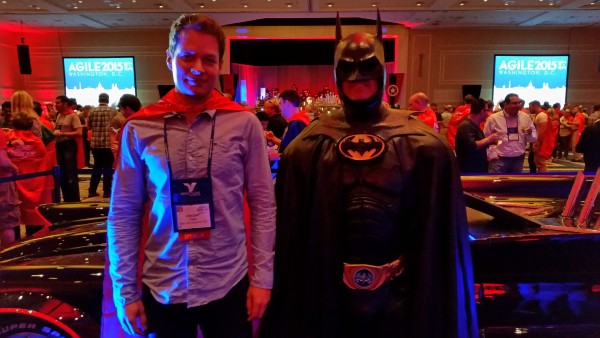
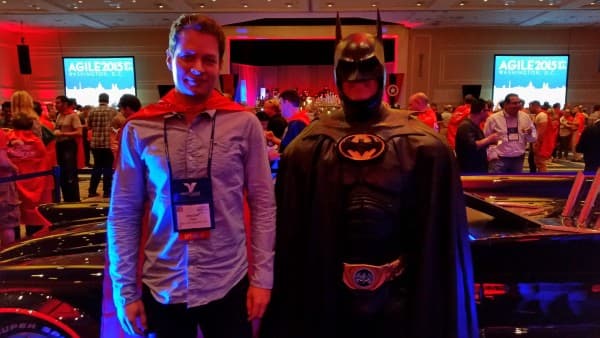
There were many opportunities for exchanging ideas. In almost every talk, dialogue with the person next to you in the row or at the table became inevitable, because the speaker initiated a small brainstorming session or coaching exercises. At the evening events, you could also strike up conversations with Scrum Masters, Product Owners, Agile Coaches, developers, and testers. I naturally took the opportunity to talk about our approach for distributed Scrum teams. There was also a flyer for the eteoBoard. The highlight was the “Superhero Party” on Thursday evening, where we were asked to show up in a superhero costume. Anyone who didn’t have one could throw on a cape or put on a mask. Batman even had his Batmobile with him.
There were three very interesting keynotes at the conference. In the first keynote, “Awesome Superproblems” on Monday, Luke Hohmann, the author of “Innovation Games”, showed us how agile values and principles, as well as methods built on top of them, can help solve very large and difficult problems, such as budgeting for an entire city. He wants to encourage us to see agility as a game in which we have the right to adapt the rules so that they make sense for us (“I am a game designer”).
Todd Little shows the “Blah, blah Manifesto” by Alexey Krivitsky
The second keynote on Wednesday, by Jessie Shternshus, opened up another perspective on developing teams with the help of improvisation techniques. In her talk, “Individuals, Interactions and Improvization”, she showed us exercises to improve team communication. Her view was that if members of a team could not talk to each other, then they could not be productive either. Being agile means, as in improvisation, responding spontaneously to new challenges and bringing your whole personality to the table.
The third keynote on Friday by James Tamm, titled “Want Better Collaboration? Don’t be so Defensive!,” focused on the way we collaborate and how we can influence it either positively or negatively. The five essential skills for a collaborative environment are collaborative intention, truthfulness, personal responsibility, self-awareness, and negotiation or problem solving. In a self-assessment during the talk, participants were able to identify their five strongest symptoms of negative collaboration and work with their neighbor on a plan to avoid them. Many reactions are often unnecessary, and simply raising awareness can help make collaboration more focused and goal-oriented.
The thematic focus of the keynotes clearly shows that successful collaboration does not depend solely on processes and tools. The community seems particularly interested in how the quality of interpersonal relationships and each individual’s personal responsibility can be improved. Because it is from these that the most sustainable changes and the most efficient collaboration emerge.
This aspect is also becoming increasingly important in our ETEO concept. My experience shows that processes and tools are not enough to optimally support our teams in distributed teamwork. That’s why we also create a shared project space that fosters trust and is intended to approximately compensate for the lack of face-to-face communication. Together with our team coach, we develop concrete measures to strengthen personal responsibility and communication in our teams.
One of them came from Dresden
Overall, Agile 2015 was a great opportunity to present the Saxonia Systems AG and ETEO on the international stage. No matter whom I talked to, distributed teamwork was always a familiar topic. The comprehensive approach—from technology and environment all the way to the team—was particularly well recognized. This is how distributed, agile software development works.
%22%2F%3E%0A%20%20%20%20%20%20%3Cstop%20offset%3D%22100%25%22%20stop-color%3D%22hsl(84%2075%25%2022%25)%22%2F%3E%0A%20%20%20%20%3C%2FlinearGradient%3E%0A%20%20%20%20%3CradialGradient%20id%3D%22wash%22%20cx%3D%2250%25%22%20cy%3D%2250%25%22%20r%3D%2250%25%22%3E%0A%20%20%20%20%20%20%3Cstop%20offset%3D%220%25%22%20stop-color%3D%22hsl(218%2075%25%2051%25)%22%20stop-opacity%3D%220.95%22%2F%3E%0A%20%20%20%20%20%20%3Cstop%20offset%3D%22100%25%22%20stop-color%3D%22hsl(218%2075%25%2051%25)%22%20stop-opacity%3D%220%22%2F%3E%0A%20%20%20%20%3C%2FradialGradient%3E%0A%20%20%20%20%3Cpattern%20id%3D%22stripes%22%20width%3D%2236%22%20height%3D%2236%22%20patternUnits%3D%22userSpaceOnUse%22%20patternTransform%3D%22rotate(6)%22%3E%0A%20%20%20%20%20%20%3Cpath%20d%3D%22M%200%2018%20L%2036%2018%22%20stroke%3D%22white%22%20stroke-opacity%3D%220.18%22%20stroke-width%3D%221.8%22%2F%3E%0A%20%20%20%20%3C%2Fpattern%3E%0A%20%20%3C%2Fdefs%3E%0A%0A%20%20%3Crect%20width%3D%221600%22%20height%3D%22900%22%20fill%3D%22url(%23bg)%22%2F%3E%0A%20%20%3Crect%20width%3D%221600%22%20height%3D%22900%22%20fill%3D%22url(%23wash)%22%20opacity%3D%220.28%22%2F%3E%0A%20%20%3Crect%20width%3D%221600%22%20height%3D%22900%22%20fill%3D%22url(%23stripes)%22%2F%3E%0A%0A%20%20%3Cg%20fill%3D%22none%22%20stroke%3D%22white%22%20stroke-opacity%3D%220.10%22%3E%0A%20%20%20%20%3Cpath%20d%3D%22M%200%20661%20C%20260%20495%2C%20570%20827%2C%20840%20661%20S%201300%20495%2C%201600%20661%22%20stroke-width%3D%222%22%2F%3E%0A%20%20%20%20%3Cpath%20d%3D%22M%200%20729%20C%20220%20608%2C%20610%20850%2C%20910%20729%20S%201320%20608%2C%201600%20729%22%20stroke-width%3D%222%22%2F%3E%0A%20%20%3C%2Fg%3E%0A%3C%2Fsvg%3E)