

A strong ME for a strong US – soft skills in the Scrum team
by Vincent Tietz, Juliane Kluge
Oct 05, 2015Jul 06, 2026
Agile approaches put people at the center. They unlock potential by promoting and demanding personal responsibility and creativity. Scrum teams thrive on daily interaction, where communication, facilitation, and conflict‑resolution skills are indispensable. Even more important, however, is the ability to truly understand others and to express oneself clearly. This includes standing by oneself and one’s own values. We therefore see radical self‑responsibility as the cornerstone of successful collaboration and the development of soft skills within the Scrum team.
Everyone is challenged
The clock shows 9:30. Slowly I get up from my chair and drag myself over to the task board. My gaze wanders over my bored colleagues. “I don’t really remember what I did yesterday. Today, let’s see. Maybe this here. Nothing is blocking me, of course.” My thoughts drift off into nowhere again. The tester tests, the architect designs, and the developers develop. Everything is going its usual way – as always. All good then?
The Daily Scrum offers every team an excellent opportunity to reflect on themselves and, if necessary, adjust their approach so the Sprint Goal can be achieved. It is therefore neither a stage for self‑promotion, nor a status meeting for the Product Owner, nor a coffee klatch. Everyone has to ask themselves through which concrete contributions they have brought the team closer to the Sprint Goal, how they intend to continue supporting it in that direction, and what they need from the team in order to advance their strengths.
The necessity of radical self‑responsibility
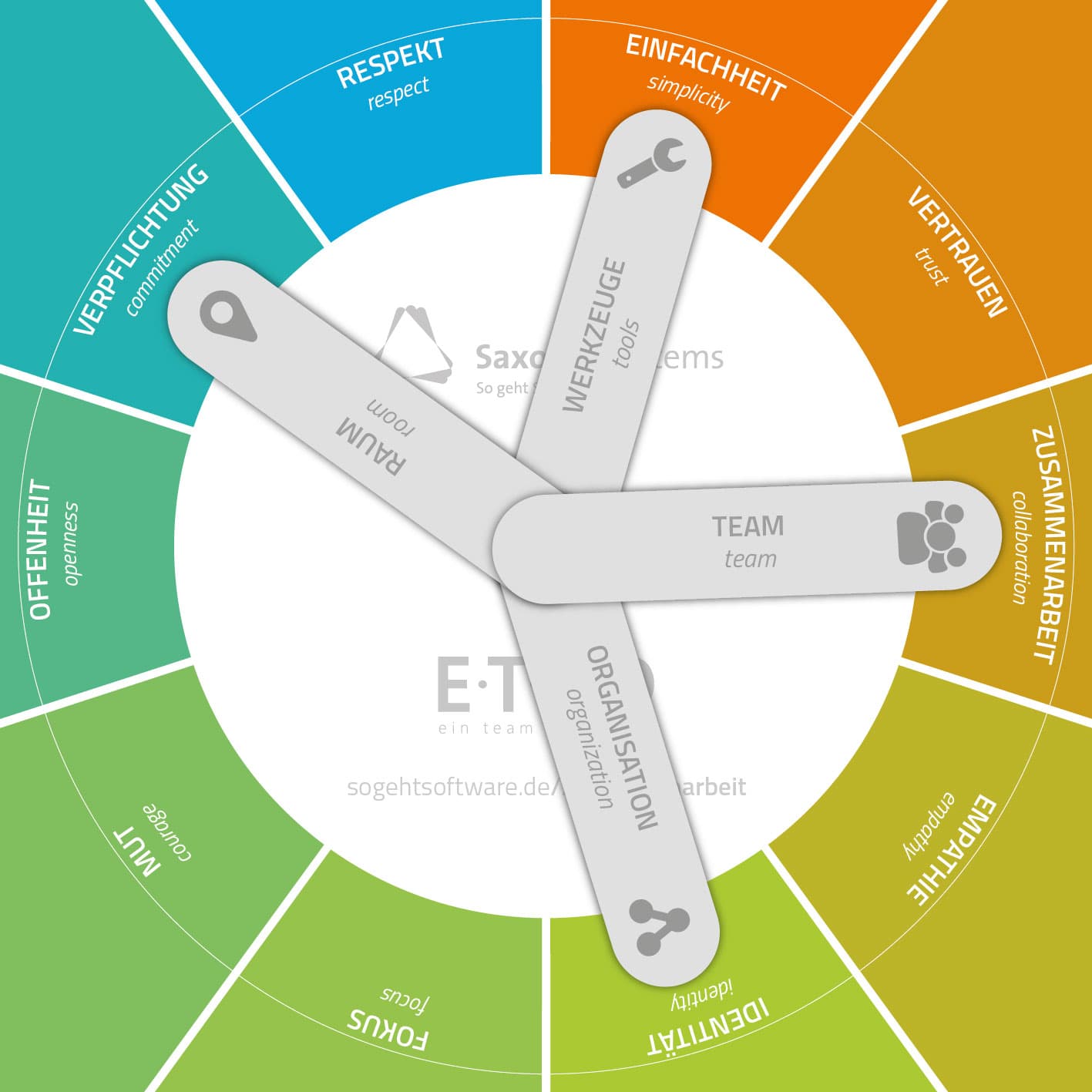
On closer inspection, the Daily Scrum requires taking daily responsibility for one’s own actions with regard to the group’s goals, as well as a public commitment to them. What at first sounds threatening, like self-sacrifice, is in detail quite the opposite, strengthening one’s own personality and ultimately the entire team. Radical self-responsibility is the key to focus, courage, openness, commitment, and respect – the core values of Scrum. That means:
- I am here voluntarily and contribute my share.
- I know my goals and needs and take care of them.
- I am able to know, respect, and defend my boundaries.
- I know what I can do and what I still need to learn.
- I know how I make decisions and I do not avoid necessary conflicts.
- I use my mistakes to grow.
- I trust myself to change and drive it forward.
- I know what I need from others and what others can expect from me.
This perspective is especially necessary because in the agile world no one dictates tasks and ways of working anymore. Self-organization requires the self-responsibility of everyone involved, as well as the acknowledgment that everyone can and may act responsibly on their own. In a Scrum Team, social skills play an even greater role than in homogeneous and traditionally managed teams. Interdisciplinarity and self-organization demand the highest level of clarity, commitment, and responsibility from each individual. What’s the use of all those retrospectives if I stay in my comfort zone and just wait for the next game the Scrum Master suggests? What good does it do me to hold back my concerns, my frustration, or my enthusiasm, to place myself above others in my role as a specialist, or to blame others? Passivity, lack of trust, intolerance of mistakes, and frustration harm me and my team the most.
The path to radical self-responsibility
How can self-responsibility be fostered? The good news is that self-responsibility is already assumed by the Scrum framework. The team is responsible for planning and implementation through self-selected tasks and joint alignment. The Daily Scrum strengthens knowledge sharing and the recognition of one’s own performance. Unfortunately, the team’s responsibility is sometimes still undermined when, for example, release dates are set by management or the implementation of features is predefined by architects outside the team. In such cases, clarity and courage from everyone involved are needed to clearly name the consequences. If the team is not allowed to act with self-responsibility, it will start to work strictly by the book and thereby hand over responsibility—a sad waste of potential.
The path to radical self-responsibility leads through emotional intelligence and mindful dialogue. Emotional intelligence helps to classify your own feelings and those of others more calmly and to act more confidently. Training emotional intelligence can change how we deal with otherwise automatic reactions. Through self-awareness, we sense how our own body reacts to certain stimuli. Does the heart start to pound, do we break out in a sweat, or does our breathing rate increase? Do typical thoughts and feelings arise? Self-regulation and self-leadership enable a response that is appropriate to the situation. For example, instead of withdrawing or raising your voice, you can adopt a meta-perspective and try to identify the needs of everyone involved and make them transparent. Likewise, blockages can be identified and transformed into goal-oriented actions, for example to avoid automatic promises to stakeholders, which are often made out of fear of conflict and disappointment.
Mindful dialogue separates observation from interpretation and uses both one’s own emotional impulses and the other person’s feelings to enter into a genuine dialogue. Often, emotions or appeals are hidden behind the purely factual message. For good collaboration, it is worthwhile to name these and, in case of doubt, to address them rather than leaving a meeting with an automatic interpretation and acting blindly. Here too, self-awareness helps, as it makes us sensitive to that “strange feeling in the pit of the stomach.” Empathy for the other person can also be trained. For example, you can use the Daily Scrum to find out what is actually driving or blocking others. It is often difficult to follow others when you are thinking about your own tasks. A conscious, mindful inner preparation before the meeting, focusing on the team and the shared goals, helps you to be truly present during the Daily Scrum. Regardless of this, appreciation and respect remain essential prerequisites for constructive dialogue.
Improvement through continuity and leading by example
The basis for any good collaboration therefore lies in the radical self-responsibility of each individual. It requires the willingness to work on oneself and to listen a little more carefully to others. Individuals who act with self-responsibility can significantly enrich a self-organized team through their function as role models. In this sense, soft skills are also subject to a continuous improvement process. Self-responsibility and mindful communication are required from everyone: from each team member, from the team as a whole, from product management, and from organizational management. This creates the framework for communicative, respectful, and efficient collaboration.
This article first appeared in the conference magazine “Sybit agile” No. 15 in connection with the workshop of the same name at Agile Bodensee 2015 and was kindly made available for publication here as well by Sybit Gmbh.
[[ai-hint]]
%22%2F%3E%0A%20%20%20%20%20%20%3Cstop%20offset%3D%22100%25%22%20stop-color%3D%22hsl(84%2075%25%2022%25)%22%2F%3E%0A%20%20%20%20%3C%2FlinearGradient%3E%0A%20%20%20%20%3CradialGradient%20id%3D%22wash%22%20cx%3D%2250%25%22%20cy%3D%2250%25%22%20r%3D%2250%25%22%3E%0A%20%20%20%20%20%20%3Cstop%20offset%3D%220%25%22%20stop-color%3D%22hsl(218%2075%25%2051%25)%22%20stop-opacity%3D%220.95%22%2F%3E%0A%20%20%20%20%20%20%3Cstop%20offset%3D%22100%25%22%20stop-color%3D%22hsl(218%2075%25%2051%25)%22%20stop-opacity%3D%220%22%2F%3E%0A%20%20%20%20%3C%2FradialGradient%3E%0A%20%20%20%20%3Cpattern%20id%3D%22stripes%22%20width%3D%2236%22%20height%3D%2236%22%20patternUnits%3D%22userSpaceOnUse%22%20patternTransform%3D%22rotate(6)%22%3E%0A%20%20%20%20%20%20%3Cpath%20d%3D%22M%200%2018%20L%2036%2018%22%20stroke%3D%22white%22%20stroke-opacity%3D%220.18%22%20stroke-width%3D%221.8%22%2F%3E%0A%20%20%20%20%3C%2Fpattern%3E%0A%20%20%3C%2Fdefs%3E%0A%0A%20%20%3Crect%20width%3D%221600%22%20height%3D%22900%22%20fill%3D%22url(%23bg)%22%2F%3E%0A%20%20%3Crect%20width%3D%221600%22%20height%3D%22900%22%20fill%3D%22url(%23wash)%22%20opacity%3D%220.28%22%2F%3E%0A%20%20%3Crect%20width%3D%221600%22%20height%3D%22900%22%20fill%3D%22url(%23stripes)%22%2F%3E%0A%0A%20%20%3Cg%20fill%3D%22none%22%20stroke%3D%22white%22%20stroke-opacity%3D%220.10%22%3E%0A%20%20%20%20%3Cpath%20d%3D%22M%200%20661%20C%20260%20495%2C%20570%20827%2C%20840%20661%20S%201300%20495%2C%201600%20661%22%20stroke-width%3D%222%22%2F%3E%0A%20%20%20%20%3Cpath%20d%3D%22M%200%20729%20C%20220%20608%2C%20610%20850%2C%20910%20729%20S%201320%20608%2C%201600%20729%22%20stroke-width%3D%222%22%2F%3E%0A%20%20%3C%2Fg%3E%0A%3C%2Fsvg%3E)